
American Silver Eagle Guide: What Beginners Should Know
Aug 28th 2026
Updated August 2026
The American Silver Eagle is one of the most recognizable modern U.S. coins, and for many people it serves as an introduction to both silver and coin collecting.
At first glance, the series seems straightforward. A standard American Silver Eagle contains one troy ounce of silver, carries a $1 face value, and features the familiar Walking Liberty design. But once you begin shopping, you quickly encounter terms such as BU, Proof, Uncirculated, MS-69, MS-70, mint mark, Type 1, Type 2, and reverse Proof.
You do not need to understand every variety before buying your first coin. It does help, however, to understand what you are buying and whether your goal is primarily to own silver, build a coin collection, or do some combination of the two.
Currency & Coin has worked with collectors since 1993, and one lesson has remained consistent: collecting is more enjoyable when you understand the coins before deciding what belongs in your collection.
What Is an American Silver Eagle?
The American Silver Eagle is the official silver bullion coin of the United States. The series began in 1986 as part of the American Eagle coin program.
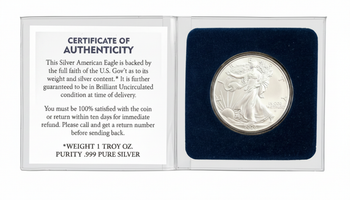
The obverse uses Adolph A. Weinman's Walking Liberty design, originally introduced on the Walking Liberty half dollar in 1916. It depicts Liberty walking toward the rising sun while carrying branches of laurel and oak.
From 1986 into 2021, the reverse used John Mercanti's heraldic eagle design. During 2021, the U.S. Mint introduced a redesigned Silver Eagle with a new reverse by Emily Damstra showing an eagle approaching a landing while carrying an oak branch. The obverse was also refreshed to more closely reflect details of Weinman's original design.
Collectors commonly refer to the original version as the Type 1 Silver Eagle and the redesigned version as the Type 2 Silver Eagle.
That makes 2021 particularly interesting because both major design types were issued with the same date.
Basic American Silver Eagle Specifications
A standard American Silver Eagle has these basic specifications:
- Denomination: $1
- Silver content: 1 troy ounce
- Composition: 99.9% silver
- Weight: 31.103 grams
- Diameter: 40.60 mm
- Edge: Reeded
The $1 denomination makes the American Silver Eagle legal-tender U.S. coinage, but its face value is not a practical indication of what the coin is worth in the marketplace. The silver contained in the coin alone is normally worth considerably more than its $1 denomination.
That is an important distinction for beginners. The denomination stamped on a precious-metal coin is not necessarily what determines the price collectors or bullion buyers will pay for it.
Bullion, BU, Proof, and Uncirculated Silver Eagles
One of the first confusing parts of collecting American Silver Eagles is that coins with essentially the same basic design can be produced and sold in several different formats.
Understanding those formats can prevent a lot of confusion.
Bullion and BU Silver Eagles
The standard bullion American Silver Eagle is produced primarily as a precious-metals product. Unlike the Mint's collector versions, bullion Silver Eagles are not sold directly to individual customers by the U.S. Mint. They enter the marketplace through the Mint's network of Authorized Purchasers and ultimately reach coin dealers and other retailers.
Dealers frequently describe attractive uncirculated examples as BU, meaning Brilliant Uncirculated.
Standard bullion Silver Eagles generally do not carry a mint mark. This can occasionally be confusing because grading services may attribute some bullion coins to a particular production facility when sufficient documentation exists.
For a beginning collector, the important distinction is simple: an attribution printed on a grading-service label is not the same thing as a mint mark actually struck on the coin.
A regular BU bullion Silver Eagle is often the simplest version of a particular date to buy.
Proof Silver Eagles
Proof Silver Eagles are produced specifically for collectors.
Their specially prepared surfaces and striking process produce a distinctly different appearance from regular bullion coins, generally with reflective fields and frosted design elements.
Proof Silver Eagles normally carry a mint mark identifying the facility associated with the issue. West Point Proofs, for example, carry a W, while Silver Eagle Proofs have also been produced at other Mint facilities for certain issues.
Proof Silver Eagles usually sell for considerably more than ordinary bullion versions because they are numismatic collector products rather than simply another way to purchase an ounce of silver.
Collector Uncirculated Silver Eagles
There is also an official U.S. Mint collector version known as the American Eagle Silver Uncirculated Coin.
The Mint introduced this version in 2006. Collectors frequently call it a burnished Silver Eagle because specially burnished blanks are used in its production.
These coins should not be confused with ordinary BU bullion Silver Eagles.
The collector Uncirculated Silver Eagle has traditionally been produced at West Point and carries a W mint mark.
So although the terminology can sound similar:
BU bullion Silver Eagles and U.S. Mint Uncirculated Silver Eagles are not the same product.
Reverse Proofs and Other Special Finishes
The U.S. Mint has also produced Silver Eagles in special formats for anniversary sets and other collector products.
One example is the reverse Proof. As the name suggests, its appearance essentially reverses the traditional Proof look: the fields are frosted while the raised design elements are more reflective.
Other special finishes and issues have appeared throughout the history of the series.
A new collector does not need to pursue all of them. Trying to acquire every special Silver Eagle immediately is an easy way to turn a relatively straightforward collection into a complicated—and potentially expensive—one.
Start by understanding bullion, Proof, and collector Uncirculated Silver Eagles. Special issues can come later if they interest you.
Why Are American Silver Eagles So Popular With Collectors?
Silver Eagles combine several characteristics that make them approachable to collectors.
They contain a standardized amount of silver, are issued by the U.S. Mint, and feature one of the most familiar designs in American coinage. The series also began relatively recently, in 1986, making its history more manageable than many U.S. coin series extending back into the 19th century.
There is also considerable flexibility in how Silver Eagles can be collected.
One person might buy one bullion coin from every year. Another might collect Proof Silver Eagles in their original U.S. Mint packaging. Someone else may prefer professionally graded examples or focus on special finishes and varieties.
None of those approaches is inherently more "correct" than another.
Collecting Silver Eagles vs. Buying Silver
This is one of the most important distinctions for a new buyer to understand.
A bullion Silver Eagle has an obvious connection to the silver market because it contains one troy ounce of .999 fine silver. Someone primarily interested in precious-metal content will generally pay close attention to the amount of silver being purchased and the premium being paid above the value of that silver.
A coin collector may evaluate the same Silver Eagle differently.
Collectors may care about:
- Date
- Mint mark
- Finish
- Condition
- Original packaging
- Design type
- Special issues or varieties
- Professional certification
- Completeness of a set
Once you begin paying additional money for those characteristics, you are moving beyond simply purchasing an ounce of silver and into numismatic collecting.
There is nothing wrong with either approach. The important thing is knowing which approach you are taking.
If your primary objective is silver content, for example, paying a substantial additional premium for a certified MS-70 coin may not accomplish much for your particular goal.
If you are deliberately building a matched certified collection, however, grade and holder may matter considerably to you.
Dates, Mint Marks, Designs, and Finishes
A beginning collector should learn to look beyond the large date on the front of a Silver Eagle.
The date tells you the year of issue, but two Silver Eagles carrying the same date are not necessarily the same collectible.
A mint mark, when present, identifies the Mint facility associated with that particular collector issue. Proof and collector Uncirculated Silver Eagles can carry mint marks, while standard bullion Silver Eagles generally do not.
The finish tells you something about how the coin was produced. Bullion, Proof, Uncirculated, reverse Proof, enhanced finishes, and other special issues can represent distinctly different collector products.
The design type matters as well. The major dividing point is 2021, when the series transitioned from John Mercanti's heraldic eagle reverse to Emily Damstra's landing-eagle design. The redesigned Silver Eagle also introduced enhanced security features, including a variation in the reeded edge.
These distinctions become increasingly important if you decide to build a more advanced Silver Eagle collection.
Raw vs. Professionally Graded Silver Eagles
Silver Eagles are widely available both raw and certified.
A raw coin simply has not been encapsulated and graded by a third-party grading service. It may still be protected in a capsule, tube, album, flip, or original U.S. Mint packaging.
A certified Silver Eagle has been authenticated, evaluated for condition, assigned a grade, and encapsulated by a professional grading service.
For modern bullion Silver Eagles, two grades you will encounter frequently are MS-69 and MS-70. Proof coins use Proof grading designations rather than MS.
On the 70-point grading scale, 70 represents the highest numerical grade, while 69 describes a coin that falls just short of that level because of a very minor imperfection or imperfections.
For a beginning collector, however, the important question isn't simply which number is higher.
It is whether the difference matters enough to you to justify the difference in price.
Do You Need MS-69 or MS-70 Silver Eagles?
No.
There is no requirement that a serious Silver Eagle collection consist of MS-70 coins.
An accurately graded MS-69 Silver Eagle can be an extremely attractive coin. Raw BU examples can also be perfectly suitable for a collection, particularly if you enjoy assembling a traditional date set.
MS-70 coins appeal to collectors who specifically want coins certified at the highest numerical grade. That is a legitimate collecting preference, but it is a preference—not a prerequisite for collecting Silver Eagles.
Before paying substantially more for an MS-70 coin, ask yourself what the extra money is buying.
If your answer is, "I specifically want to build a matched set of 70-grade Silver Eagles," the premium may fit your collecting goal.
If the answer is simply, "I assumed 70 is what I'm supposed to buy," it may be worth looking at the alternatives first.
Common Mistakes When Buying American Silver Eagles
Silver Eagles become relatively easy to understand once you know the terminology, but beginning collectors tend to encounter a few recurring problems.
Confusing BU with the Mint's collector Uncirculated version. Both can be uncirculated coins, but they are different products. Look at the mint mark and understand which version is actually being offered.
Paying for a grade without understanding it. A higher numerical grade does not automatically make a coin the right choice for your collection. Compare the cost of raw, MS-69, and MS-70 examples and decide what matters to you.
Assuming every older date is scarce. Age alone does not make a coin rare. Production, survival, collector demand, condition, and other factors all affect availability.
Ignoring the difference between bullion and collector premiums. Two Silver Eagles containing the same amount of silver can sell for very different prices because of finish, condition, certification, packaging, or collector demand.
Handling coins carelessly. Silver Eagles are large coins with broad, exposed surfaces. Fingerprints, scratches, spots, and other problems can affect their appearance. Handle an unprotected coin by its edge and avoid touching the surfaces.
Cleaning a coin. Do not polish or clean a Silver Eagle to make it look "better." Cleaning can permanently alter the coin's surfaces and make it less desirable to collectors.
Buying before deciding what you want to collect. There is nothing wrong with accumulating Silver Eagles simply because you like them. But if your goal is to build a coherent set, having a basic plan can save both money and confusion.
Sensible Ways to Start a Silver Eagle Collection
You do not need to begin with the most expensive or complicated version of the series.
One simple approach is a bullion date set: one standard Silver Eagle from each year. This lets you follow the history of the series while keeping the basic format relatively consistent.
Another option is a Proof date set. Proof Silver Eagles have a distinctly different appearance and were produced specifically for collectors.
You could also collect the two major design types, acquiring a Type 1 coin with the original heraldic eagle reverse and a Type 2 coin with the redesigned reverse introduced in 2021.
Some collectors prefer a certified set, choosing a consistent grading service and perhaps a particular grade range. Others prefer raw coins in an album or coins in their original U.S. Mint packaging.
Another very simple approach is to begin with the current year and add one new Silver Eagle each year.
And you can always simply collect the individual Silver Eagles that appeal to you.
A collection does not have to be complete to be worthwhile.
What Is Different About the 2026 American Silver Eagle?
Because 2026 marks the 250th anniversary of the United States, it is an unusual year for the American Silver Eagle series.
The standard 2026 bullion Silver Eagle is the most straightforward version. It carries the date 2026, has no mint mark, and retains the Type 2 design introduced in 2021.
Several of the Mint's 2026 collector Silver Eagles, however, are different. The West Point Proof and Enhanced Uncirculated versions feature the dual dates 1776 ~ 2026 along with a special Liberty Bell privy mark containing the numeral 250.
There are other 2026 collector variations as well, which makes it especially important this year to understand exactly which Silver Eagle you are buying.
For someone just beginning the series, that doesn't mean you need to pursue every 2026 version. In fact, a regular 2026 BU bullion Silver Eagle can still be one of the simplest ways to get acquainted with the coin.
Why a Current-Year Silver Eagle Can Be a Good Starting Point
For many beginners, buying a current-year bullion Silver Eagle is one of the easiest ways to become familiar with the series.
You can examine the design, size, edge, luster, and surfaces without immediately worrying about completing an older date set or learning every special issue.
It also gives your collection an obvious starting date.
From there, you might decide you prefer Proof Silver Eagles. You might become interested in the original Type 1 design. You might work backward one year at a time, or simply add one new coin each year.
The point isn't that a current-year Silver Eagle is better than an older one.
It is simply an uncomplicated place to begin.
If you'd like to start with the current year, Currency & Coin offers the regular 2026 BU American Silver Eagle for collectors who want a straightforward example of this year's bullion issue.
View the 2026 American Silver Eagle
Frequently Asked Questions About American Silver Eagles
Is an American Silver Eagle really one ounce of silver?
Yes. A standard American Silver Eagle contains one troy ounce of .999 fine silver. Its total specified weight is 31.103 grams.
What is the difference between a BU and a Proof Silver Eagle?
A BU Silver Eagle usually refers to a standard bullion coin in uncirculated condition. A Proof Silver Eagle is produced specifically as a collector coin using a different manufacturing process that gives it a distinctive finish. Proof coins generally carry a higher premium.
Do American Silver Eagles have mint marks?
Standard bullion Silver Eagles generally do not have mint marks. Proof and collector Uncirculated versions can have mint marks identifying the Mint facility associated with the issue.
What is the difference between Type 1 and Type 2 Silver Eagles?
Type 1 Silver Eagles use John Mercanti's original heraldic eagle reverse. In 2021, the U.S. Mint introduced the Type 2 reverse designed by Emily Damstra, depicting an eagle approaching a landing with an oak branch. Both types were produced during 2021.
Is an MS-70 Silver Eagle better than an MS-69?
MS-70 is the higher numerical grade, but that does not automatically make it the better purchase for every collector. MS-69 Silver Eagles can be extremely attractive and often cost less. Whether paying the additional premium for MS-70 makes sense depends on the type of collection you want to build.
Should I buy Silver Eagles for their silver or collect them as coins?
Either approach is legitimate, but they are different.
If your main objective is owning silver, the amount of precious metal and the premium above the silver value will probably be most important to you.
If you're building a coin collection, factors such as date, finish, mint mark, grade, packaging, design type, and special issues may also matter.
Knowing your objective before you buy can help you make better choices.
Start With the Coin, Then Decide Where the Collection Goes
American Silver Eagles can be as straightforward or as detailed as you want them to be.
You can own a single bullion coin because you appreciate the Walking Liberty design. You can build a date set, collect Proofs, pursue special finishes, or assemble professionally graded examples. You can also change direction as you learn more.
The important part is understanding what you are buying and why one Silver Eagle may cost more than another.
At Currency & Coin, we believe collectors are better served by clear information than by being told that every coin is something they need to own. Learn the series, look at different examples, understand the terminology, and then collect American Silver Eagles in the way that interests you.
That is a good way to begin any coin collection.